


Retirement is often imagined as a finish line. A point where life finally slows down, everything becomes simpler, and you finally get to enjoy the freedom you’ve worked towards for decades. But what actually happens after retirement is far more layered than most people expect.
In the early days, there’s relief. The pressure of work lifts, schedules open up, and for the first time in years, there’s space to breathe. Many older adults feel a renewed sense of freedom and possibility. But not long after, another side of retirement begins to emerge.
Things that were once easy to postpone start surfacing. Paperwork that sat untouched during busy working years. Financial and legal details that were always meant to be “handled later.” Homes that no longer feel practical or manageable. Conversations with family that feel important but uncomfortable to begin. This is the phase no one talks about.
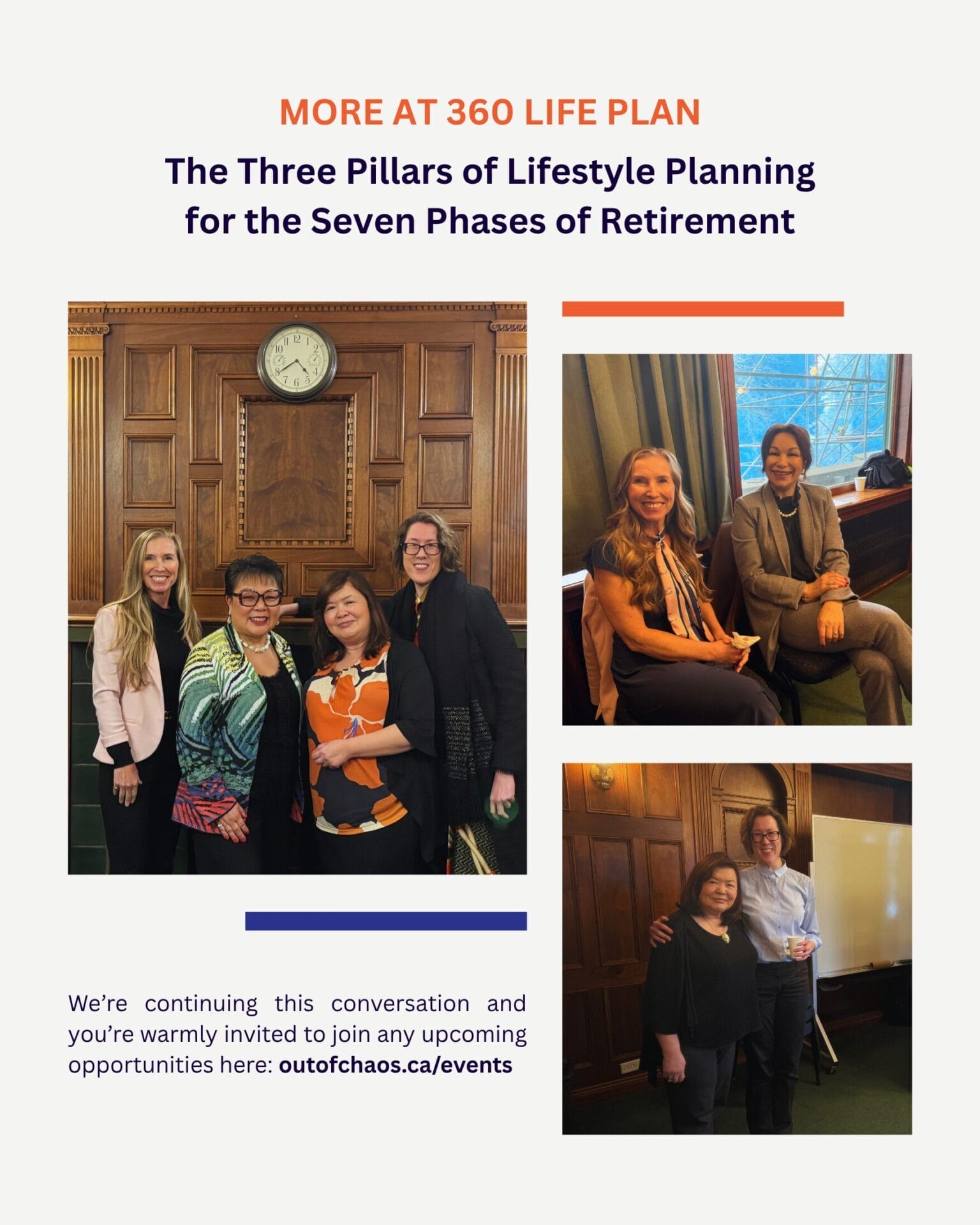
At our recent 360 Life Plan Series session, we explored the Seven Phases of Retirement. What becomes clear very quickly is that retirement is an ongoing life transition. And instead of simplifying life, it often reveals everything that hasn’t been fully dealt with.

Traditional retirement planning focuses heavily on savings, investments, and income. But real-life retirement planning goes far beyond finances. It involves navigating a shift in identity after years of working, adjusting to changes in health and energy, and stepping into evolving family roles (sometimes even becoming the one who needs support). It includes decisions about where and how you want to live, and eventually, how things should be handled when you no longer can manage them yourself.
That’s a lot to carry.
We see this every day. People don’t come to us because they failed to plan. They come because life kept changing. Health shifts, family roles evolve, homes that once worked no longer fit, paperwork accumulates, decisions get deferred, and slowly, what was supposed to feel freeing starts to feel overwhelming.
Understanding the Seven Phases of Retirement and the Importance of Planning Ahead
One of the most important ideas we shared is simple: you don’t plan for retirement once, you plan for it continuously. Retirement is not a single event or a fixed destination. It unfolds over time, moving through distinct phases, each bringing its own set of emotional, financial, and practical realities. While many people focus heavily on the moment they leave work, what follows is often far less predictable and far more complex. These phases typically include:
- Pre-retirement planning years (where financial & lifestyle decisions begin to take shape)
- Transition out of working life (which often brings a shift in identity and routine)
- The retirement “honeymoon” phase (where freedom and possibility feel most present)
Over time, many retirees experience a period of disenchantment or uncertainty, where the reality of retirement doesn’t quite match expectations. This is often followed by a stage of reorientation and adjustment, where new routines, priorities, and ways of living begin to take hold. From there, people move into a period of stability and enjoyment, before eventually facing decisions around legacy, long-term care, and end-of-life planning.
Understanding these phases changes how we approach retirement planning. It highlights the need for flexibility, ongoing decision-making, and systems that can adapt as life evolves.
For retirees in Vancouver, these transitions can feel even more complex. Longer life expectancy means retirement can span decades. Rising housing costs add pressure to decisions around downsizing or relocating, and evolving healthcare systems make planning for future care both essential and uncertain. As a result, retirement decisions become deeply practical and highly personal, extending well beyond finances.
At our session at the 360 Life Plan Series, we had the opportunity to step back and look at retirement differently: as a lived experience.
What “Getting Organized” Really Means
We often talk about three pillars of retirement planning:
- Financial Planning: creating clarity around spending, saving, and long-term sustainability.
- Insurance Protection & Planning: preparing for health events, transitions, and protecting both individuals and families.
- Organizing & Simplifying Affairs: reducing complexity so that decisions are easier, wishes are known, and transitions are smoother.
Most people focus on the first two. But it’s the third that makes everything else actually work. Because when we talk about getting organized in retirement, we’re not talking about perfectly styled spaces or colour-coded bins but preparedness. It means having enough clarity and structure in place that you can confidently answer simple but critical questions when they arise:
- Could someone step into your life and understand it within a short time?
- Could your family locate important documents without stress?
- Are your daily systems (mail, bills, medications, contacts) simple enough to manage if your capacity changes?
Without clear systems, even the best plans fall apart. Yes, you can have a strong financial plan and the right insurance in place but if no one can find documents, understand instructions, or access critical information, those plans break down when they’re needed most.
At Out of Chaos, organizing goes far beyond “stuff.” It reflects the decisions that haven’t yet been made, the conversations that haven’t yet happened, and the plans that haven’t yet been documented. In retirement, this becomes even more important. Our focus is on function and reducing friction so that your life, and everything connected to it, can be clearly understood and supported when it matters most.
A Simple Way to Start
For many families, life is more fragile than it seems. They’re managing aging parents with unclear wishes, homes filled with decades of belongings, scattered documents, and caregiving responsibilities layered onto already busy lives. Without structure, even a small disruption can quickly become overwhelming.
If you’re at this point or simply feeling like everything is becoming too much, there is a way to begin. The C.L.E.A.R. Method offers a simple and structured path forward. It starts by helping you see what you have, bringing everything into view so it feels manageable. From there, you begin to gently limit what no longer supports your current life even when that process feels emotional. You evaluate what is truly useful, create designated places for important items and information, and gradually remove what no longer serves you. At its core, the process looks like this:
- Categorize what you have so it becomes visible
- Limit what no longer fits your current life
- Evaluate what’s truly useful
- Allocate clear places for important items and information
- Remove what no longer serves you
Continuing the Conversation
If you joined us in person, we hope you gained a fresh perspective and began to dive deeper into what retirement really looks like beyond the surface. And if you weren’t able to attend, don’t worry, there’s more ahead.
Following the success of our recent event, we’re keeping the momentum going as part of the 360 Life Plan Series. Keep an eye out for more resources, insights, and upcoming opportunities to continue the conversation.
Whether you’re planning your own future or supporting someone you care about, we’re always here to help you build a structure that truly works in real life.