


If you’ve ever been part of an office move, renovation, or even a departmental reorganization, you’ve likely noticed how quickly things come into focus. Spaces that once felt “normal” are suddenly questioned. Filing cabinets are opened, shared drives reviewed, storage areas cleared, and it becomes clear that much of what exists in the workplace no longer supports how people actually work.
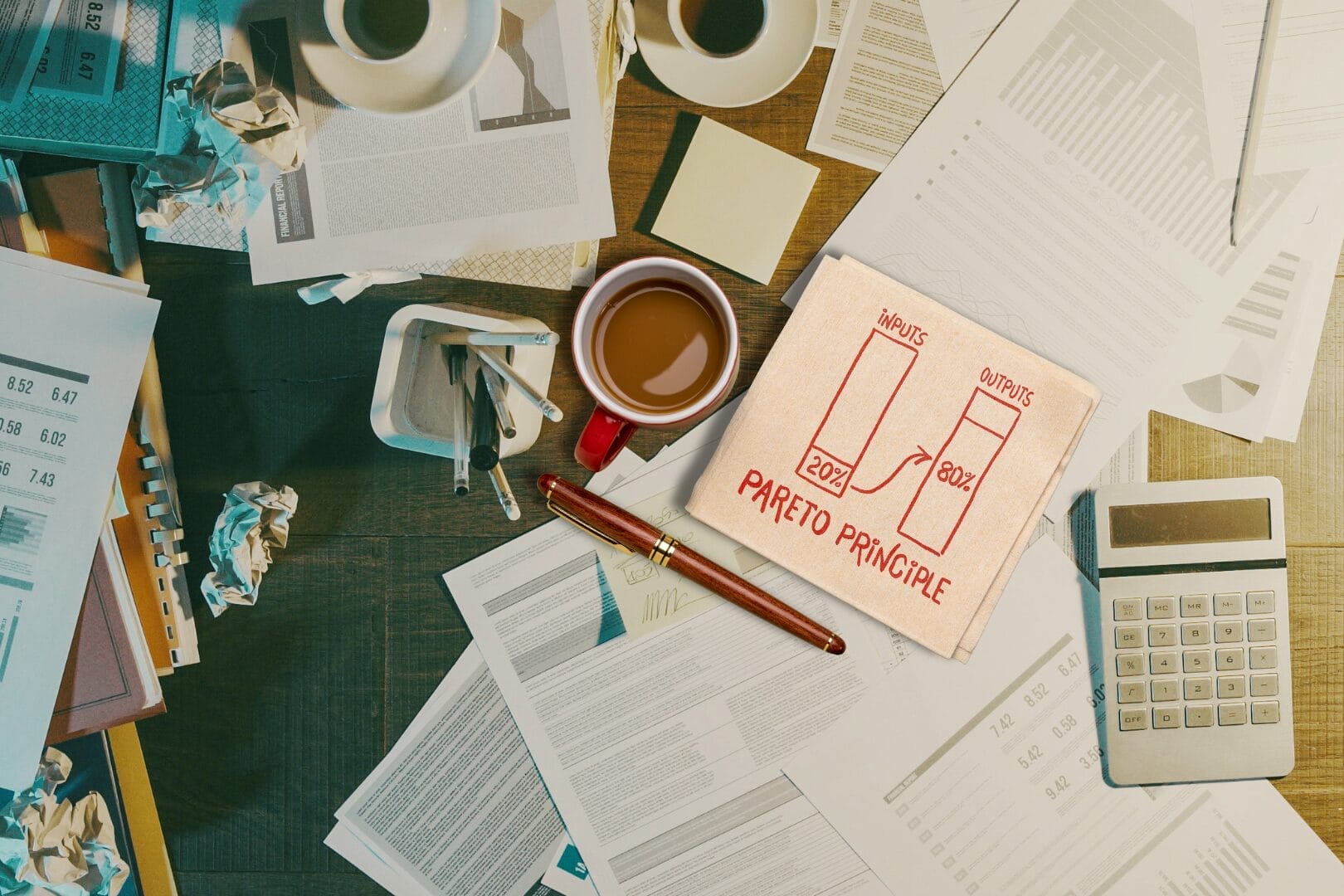
This is where the Pareto Principle (also known as the 80/20 rule) becomes especially relevant. It suggests that roughly 80% of outcomes come from 20% of inputs. In a workplace context, that usually means a small portion of tools, processes, and priorities drives the majority of meaningful results.
In most offices, however, everything accumulates as if it’s equally important. Systems expand, documents multiply, and workflows layer over time without regular evaluation. The result is an environment filled with low-use materials, redundant processes, and outdated resources that quietly add friction to how work gets done.
Office resets interrupt that pattern in a useful way. When space is limited or change is unavoidable, people are forced to make decisions they would normally postpone. You can’t keep everything “just in case,” so the questions become more direct:
- Do I actually use this?
- Does this support how I work today?
- Would I choose to bring this into my next space?
What becomes clear is that only a small portion of tools, documents, and processes truly supports day-to-day productivity. The same pattern applies to work itself: a handful of tasks, clients, and priorities generate most of the meaningful outcomes.
At that point, organizing stops being about tidying and becomes a productivity strategy. It becomes a way to reduce complexity, sharpen focus, and create a workspace that reflects real priorities. Letting go of physical clutter often becomes the starting point for letting go of low-value work, which results in an office that functions more effectively.
Translating Physical Decluttering into Workday Efficiency
Look at your current workspace. There’s likely a stack of papers you “might need,” supplies you rarely use, and digital files you haven’t opened in months. That same pattern often shows up in your workday: emails that don’t require your input, meetings that don’t move work forward, and tasks that feel urgent but don’t meaningfully contribute to results.
In most corporate environments, there’s no built-in pause to evaluate what’s actually effective. That’s why office moves and reorganizations are so valuable. They create a forced reset where teams have to ask:
- Which files are still relevant?
- Which equipment is actually used?
- Which systems do people rely on every day?
What usually becomes clear in this process is that only a small portion of resources directly supports productivity. While the rest (duplicate files, outdated systems, excess supplies, and unused tools) creates unnecessary complexity.
When teams begin applying the 80/20 mindset to their workflows, productivity shifts in practical ways. They start to:
- Prioritize the few tasks that generate the most results
- Reduce time spent searching, switching, or deciding
- Eliminate redundant tools, files, and systems
- Build workflows that are simpler and more repeatable
In other words, the mindset evolves from “Do I still need this?” in a physical sense, to “Does this actually add value to how I work?”
The Hidden Cost of Keeping Too Much
In both home offices and corporate environments, there’s a common assumption that keeping more automatically means being more prepared and flexible. On the surface, it feels responsible: more files, more tools, more systems should equal more coverage and security.
But in practice, it often produces the opposite effect.
When there’s too much to manage, work begins to slow down in subtle but persistent ways. Too many files make it harder to find what you need quickly. Too many tools create uncertainty about where tasks should actually be completed. Too many priorities make it difficult to identify what truly matters on any given day. Over time, what feels like “being prepared” turns into constant mental background noise that quietly drains focus and decision-making capacity.
Just as an overpacked office makes a move more difficult, an overloaded workflow makes daily work more effortful than it needs to be. The energy required to manage excess (physically, digitally, and mentally) is often what leads to burnout, procrastination, and inefficiency.
Office organizing, especially during transitions, creates an opportunity to remove that friction at the source. When teams focus on what is actually used and what truly supports performance, they can:
- Simplify the systems employees interact with every day
- Reduce duplication across departments and platforms
- Improve clarity in shared spaces, files, and resources
- Support faster, more confident decision-making and execution
Importantly, this process does not require a full operational overhaul. It begins with observation and pattern recognition: Which tasks consistently lead to progress? Which clients, projects, or responsibilities actually move work forward? Which tools and systems do people naturally rely on because they make work easier? Those become your “keep” items. The same way you’d decide what earns space in a well-organized office after a reset.
A Strategic Opportunity for Business Owners and Leaders
For business owners, this becomes even more meaningful. Growth rarely happens in a straight line, it comes with accumulation: more services, more tools, and more systems. Each added with good intention and meant to support expansion.
But over time, that accumulation creates complexity.
You start to feel it in daily operations: more decisions, more places to look for information, more steps between intention and execution. Work still gets done, but it takes more effort than it should.
Moments like office resets create a rare window of clarity. When the structure is disrupted, you can see how the business actually functions in reality. Patterns emerge quickly:
- A small number of services likely bring in most of your revenue
- A few key relationships drive the majority of your opportunities
- Only certain tasks truly move your business forward, while others just maintain busyness
This is where organizing becomes strategic for you. It’s not about reducing for the sake of minimalism, but about recognizing alignment. The goal is to bring your physical space, digital systems, and daily operations back in sync with what’s already working. In many cases, productivity comes from removing what no longer supports it.
When your workspace is filled with only what actively supports your priorities (your key clients, your essential tools, your core systems) decision-making becomes faster. Execution becomes smoother. Even focus improves, because your environment is no longer competing for your attention.
So instead of asking what else you should add to grow your business, use these resets to shift the question toward something more powerful: what is already driving results, and what is simply taking up space around it?
Through the lens of organizing, you can:
- Identify and double down on high-performing services or clients
- Delegate or remove low-impact tasks
- Streamline systems and operations
- Focus time on high-value work like strategy and relationships
A physical office reset also becomes a strategic reset for the business itself. What stays in the space should reflect what drives the business forward.
The Bigger Shift: A Professional Organizer Perspective
When I step into an office organizing project, I’m not just looking at what needs to be decluttered. I’m looking at how work actually flows.
That’s where we start building high-impact zones: areas designed specifically for the work that matters most, whether that’s focused production, client delivery, admin, or collaboration. Instead of treating the office as one general workspace, we restructure it around function and frequency of use, so the layout starts supporting decisions instead of slowing them down.
We also rebuild systems in a way that removes friction from daily operations. That means reducing duplicated storage, simplifying filing logic, clarifying shared systems, and making sure what people use most is the easiest to access. Small inefficiencies in office environments tend to compound quickly, so removing them has a noticeable impact on speed and focus almost immediately.
A key part of this process is helping teams let go of what’s no longer serving how they actually work today. Not just physical items, but outdated processes and unnecessary complexity that creates mental load. When that layer is removed, the shift is consistent: less searching, less second-guessing, and more time spent doing meaningful work.
What I consistently see is that office resets reveal how the business is functioning. And when we apply the 80/20 mindset intentionally, that clarity doesn’t stay in the boxes or the transition phase. It carries forward.
When an office is designed around what truly drives results, productivity stops being about effort and starts becoming about alignment. The work doesn’t change, but the way it flows does.